
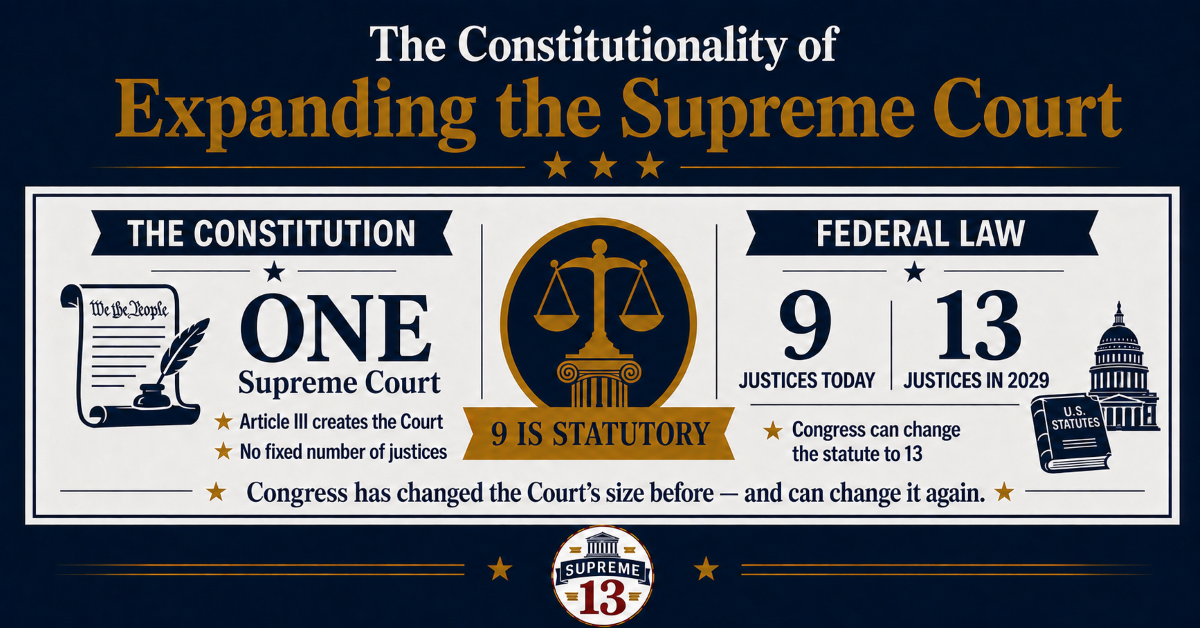
Expanding the Supreme Court from nine to thirteen justices would not require a constitutional amendment.
The reason is straightforward: the Constitution does not establish a nine-member Supreme Court. Article III creates “one supreme Court,” but it does not specify how many justices must serve on it.
Congress determines that number by statute.
As a result, Congress would not need to amend the Constitution to increase the Court from nine justices to thirteen. It would need to change the statute that currently sets the Court’s size.
How Can Congress Make This Change?
Section 1 of Title 28 of the United States Code provides that the Court “shall consist of a Chief Justice of the United States and eight associate justices.”
Nine is therefore a statutory number, not a constitutional one.
It has not always been nine.
When Congress established the Supreme Court in 1789, it provided for six justices.[1] Congress subsequently changed the Court’s authorized size repeatedly.
The Judiciary Act of 1801 provided that the Court would shrink to five justices upon its next vacancy,[2] although Congress repealed that provision in 1802 before a vacancy occurred.[3] In 1807, Congress established a seventh circuit and added a seventh justice.[4] In 1837, Congress created two additional circuits and added two more justices, bringing the Court to nine.[5]
In 1863, Congress created a tenth circuit and authorized a tenth justice.[6]
Three years later, Congress reversed course. In 1866, it provided that the Court would gradually shrink through attrition by leaving future vacancies unfilled.[7] That policy was itself reversed in 1869, when Congress established the Court’s present size of nine seats—one for each judicial circuit then in existence.[8]
Although the federal appellate system has since grown to thirteen courts of appeals,[9] Congress has left the Supreme Court at nine justices.
Congress Can Change the Number Again
This history matters because it demonstrates that nine is not a constitutionally fixed feature of the Court.
The Congressional Research Service describes the prevailing view similarly. In its report Congressional Control over the Supreme Court, CRS explains that, to the extent a proposal enlarges the Court while otherwise preserving its existing structure, “most scholars agree” that Congress may make the change through legislation. That distinction matters. Adding seats to the Court and removing sitting justices raise different constitutional questions. An effort to decrease the size of the Court by removing a sitting justice “would likely violate the constitutional requirement that federal judges enjoy life tenure during good behavior.”
To increase the size of the Supreme Court to 13 justices, Congress would need to enact legislation amending 28 U.S.C. § 1 to provide that the Court “shall consist of a Chief Justice of the United States and twelve associate justices.”
No constitutional amendment would be necessary.
For recent congressional proposals to make this change by statute, see Legislation to Expand the Supreme Court.
Expansion Does Not Remove Any Sitting Justice
Article III provides that federal judges hold their offices during “good Behaviour.” That protection is the constitutional basis for the life tenure enjoyed by Supreme Court justices.
A law that immediately abolished occupied seats as a means of removing sitting justices would likely violate Article III’s life-tenure protection.
Historically, when Congress reduced the Court’s authorized size, it did so prospectively through vacancies rather than by removing justices already in office. The 1801 law would have reduced the Court after a vacancy occurred. The 1866 law provided that vacancies would remain unfilled until the Court reached the reduced statutory size.
A straightforward expansion that adds four permanent seats presents no comparable tenure problem.
Adding four seats would not remove any sitting justice, shorten any justice’s service, or reduce any justice’s compensation. The existing nine justices would remain on the Court, and four additional justices would be appointed to the newly created seats.
Has the Supreme Court Ruled on Court Expansion?
The Supreme Court has not decided a modern challenge to a federal law adding seats to the Court. The Constitution Annotated, Congress’s nonpartisan constitutional reference, notes that the Constitution is silent regarding “the size and composition of the Supreme Court” and leaves those matters to Congress. It also explains that Congress has repeatedly changed the Court’s size and that modern expansion proposals have not been enacted.
The constitutional basis for Congress’s authority therefore rests on several mutually reinforcing sources: the text of Article III, the absence of any constitutionally prescribed number of justices, more than two centuries of congressional control over the Court’s statutory size, and repeated acts of Congress changing that size.
What About Roosevelt’s 1937 Court-Packing Plan?
The most famous modern proposal to enlarge the Supreme Court came from President Franklin D. Roosevelt in 1937.
Roosevelt proposed allowing one additional justice to be appointed when a sitting justice over age seventy and one-half declined to retire, potentially increasing the Court to as many as fifteen members.[10]
The proposal generated intense political opposition and ultimately failed in Congress. But its defeat did not establish that the Constitution requires nine justices. The proposal failed because Congress chose not to enact it, not because the Supreme Court held that Congress lacked constitutional authority to change the Court’s size.
The political and institutional arguments raised in 1937 remain relevant to the modern debate.
Opponents of Supreme Court expansion can argue that Congress should not exercise its authority because expansion could threaten judicial independence, invite retaliatory expansions, or undermine public confidence in the Court. Some critics also frame these concerns in terms of separation of powers or longstanding constitutional norms.
Those are serious arguments about how Congress should exercise its authority. But they do not establish that the Constitution fixes the Supreme Court at nine justices. The constitutional question is distinct from the political and institutional question of whether Congress should expand the Court.
The Bottom Line
The Constitution requires “one supreme Court.”
It does not require nine Supreme Court justices.
Congress established the current number by statute, just as earlier Congresses established six, seven, nine, ten, and other authorized Court sizes at different points in American history.
If Democrats win the presidency and both chambers of Congress in 2028, they could pursue legislation in 2029 to set the Court at 13 justices. For the legislative and confirmation path, see What It Will Take to Expand the Supreme Court in 2029.
The Constitution does not stand in the way of a thirteen-justice Supreme Court.
Comments
Join the conversation on Bluesky