
Congress has enacted seven changes to the authorized size of the Supreme Court since 1789, with the last change in 1869 establishing the nine-seat Court we have today.
One of the principal arguments against changing the Court's size now is that doing so for political reasons could trigger an endless cycle: Democrats add seats when they have the power, Republicans respond when they regain control, and the size of the Court becomes another front in partisan warfare.
There is a serious concern behind that argument. But it leaves out an important part of modern history.
Senate Republicans had already demonstrated in 2016 that they were willing to manipulate the Court's effective composition for political advantage by deliberately leaving a seat vacant until after the presidential election.
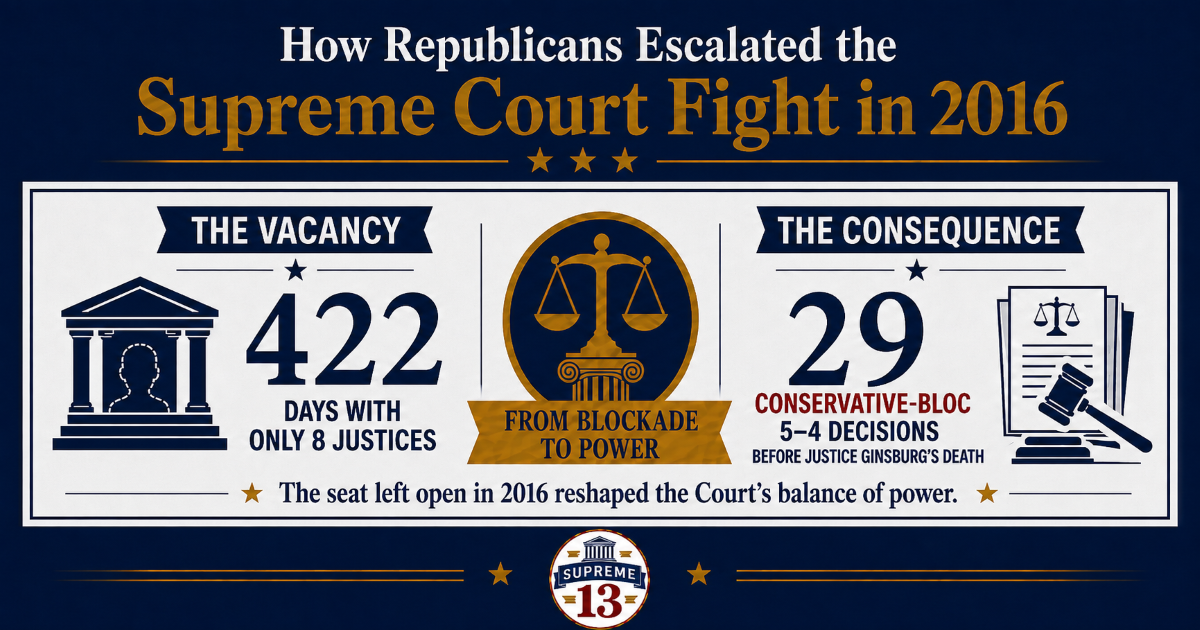
The Republicans did not formally change the law establishing a nine-seat Supreme Court. Instead, they deliberately kept one of those nine seats vacant until a new president could take office. The practical result was that for 422 days, a Court authorized to have nine justices operated with only eight.
An Eight-Justice Court by Design
At the beginning of 2016, five Supreme Court justices had been appointed by Republican presidents and four by Democratic presidents. The Republican appointees were Chief Justice John Roberts and Justices Antonin Scalia, Anthony Kennedy, Clarence Thomas, and Samuel Alito. The Democratic appointees were Justices Ruth Bader Ginsburg, Stephen Breyer, Sonia Sotomayor, and Elena Kagan.
Justice Scalia died on February 13, 2016. His death created the possibility that President Barack Obama could appoint a fifth Democratic-appointed justice, producing the first Supreme Court majority appointed by Democratic presidents since 1969.
On March 16, President Obama nominated Merrick Garland to fill Justice Scalia's seat. But Senate Republicans, led by Majority Leader Mitch McConnell, refused to hold a confirmation hearing or vote on his nomination, arguing that because the vacancy arose during a presidential-election year, voters should have a voice in determining who would fill it.
Garland's nomination remained pending for 293 days and was returned when the 114th Congress ended on January 3, 2017. President Donald Trump subsequently nominated Neil Gorsuch, and the Senate confirmed Gorsuch, who assumed office on April 10, 2017.
From Scalia's death until Gorsuch took his seat, 422 days passed with only eight justices on a Court authorized to have nine.
The practical consequence was clear. The sitting Democratic president was prevented from filling an existing Supreme Court vacancy, and the choice of justice was transferred to his Republican successor.
What an Eight-Member Court Meant
The vacancy had immediate consequences.
With only eight members, neither four-justice bloc could form a majority on its own. In cases that divided 4–4, the lower-court judgment remained in place without a precedential Supreme Court ruling.
One important example was United States v. Texas (2016). Texas and other states had challenged the Obama administration's Deferred Action for Parents of Americans and Lawful Permanent Residents program, known as DAPA, along with an expansion of Deferred Action for Childhood Arrivals (DACA). A federal district court issued a preliminary injunction blocking the policies, and a conservative panel of the Fifth Circuit affirmed. The Supreme Court then divided 4–4, leaving the Fifth Circuit's ruling and the district court's injunction intact.
A ninth justice could have broken that tie, but the Senate's refusal to act on Garland's nomination ensured that the Court remained at eight through the remainder of Obama's presidency.
The consequences became even clearer after Gorsuch joined the Court.
From Friedrichs to Janus
Perhaps the cleanest example involves public-sector unions.
In 1977, the Court in Abood v. Detroit Board of Education allowed public-sector unions to collect certain “agency fees” from employees who declined to join the union but were represented by it in collective bargaining.
The Court reconsidered that rule in Friedrichs v. California Teachers Association in January 2016, while Scalia was still alive. But Scalia died before the decision was issued. In March 2016, the remaining eight justices divided 4–4, leaving Abood intact.
Two years later, with Gorsuch occupying Scalia's seat, the Court returned to the issue in Janus v. AFSCME (2018). This time the five Republican-appointed justices formed a majority and, by a 5–4 vote, held that compulsory public-sector agency fees violated the First Amendment, expressly overruling Abood.
The sequence is difficult to ignore. An eight-member Court divided 4–4 and preserved the precedent. Gorsuch then filled the seat that Garland had been nominated to occupy, and the resulting 5–4 majority overruled that 41-year-old precedent.
Travel, Elections, and the Power of the Fifth Vote
Other major decisions followed the same voting pattern.
In Trump v. Hawaii (2018), the five Republican-appointed justices upheld President Trump's travel ban. The Court reversed the Ninth Circuit, which had concluded that the proclamation exceeded the President's statutory authority.
In Rucho v. Common Cause (2019), the five Republican-appointed justices held that claims of unconstitutional partisan gerrymandering are political questions that federal courts cannot adjudicate. Notably, Justice Kagan warned in dissent:
Of all times to abandon the Court's duty to declare the law, this was not the one. The practices challenged in these cases imperil our system of government. Part of the Court's role in that system is to defend its foundations. None is more important than free and fair elections.
Again, Gorsuch was one of the five Republican-appointed justices in the majority, while all four Democratic-appointed justices dissented.
Twenty-Nine 5–4 Decisions
These were not isolated cases.
The Harvard Law Review publishes annual statistics identifying the coalitions that constitute the majority in the Supreme Court's 5–4 full-opinion decisions.
During the portion of the 2016 Term after Gorsuch joined the Court, the five Republican-appointed justices formed the majority in 2 such cases. During the 2017 Term, the Republican-appointed justices formed the majority in 13. After Kennedy retired and was replaced by Kavanaugh, the Republican-appointed justices formed the majority in 7 cases during the 2018 Term and another 7 during the 2019 Term.
That is 29 separate 5–4 decisions in which Gorsuch joined the Court's four other Republican-appointed justices to constitute the majority.
Had Garland instead occupied that seat, the Court during this period would have contained five justices appointed by Democratic presidents and four appointed by Republican presidents. That does not mean Garland necessarily would have voted with Ginsburg, Breyer, Sotomayor, and Kagan in all 29 cases. His vote in many of them cannot be known. But the five-justice Republican-appointed bloc that decided those cases would not have existed.
The "Rule" Changed Again in 2020
The justification offered by McConnell in 2016 that voters should decide which president would fill a Supreme Court vacancy that arose during a presidential-election year, incredibly, no longer applied when the President was a Republican.
When Justice Ginsburg died on September 18, 2020, less than seven weeks before another presidential election, the Republican-controlled Senate did not wait for the voters. It confirmed Amy Coney Barrett on October 26, just eight days before Election Day.
The contrast made clear that the operative principle was not simply that election-year Supreme Court vacancies should remain open. The operative principle was simply that the politicians with power were going to exercise it to achieve their preferred outcome with respect to the composition of the Supreme Court.
What 2016 Means for the Court-Size Debate in 2029
When commentators today argue that Democrats should not expand the Supreme Court because doing so for political reasons could begin a cycle of partisan retaliation, the history of 2016 cannot be ignored.
Senate Republicans did not literally amend the statute fixing the Supreme Court at nine seats. But they deliberately prevented one of those nine seats from being filled, forcing the Court to operate with eight justices until a Republican president could choose the ninth.
That decision altered the Court's effective composition and the balance of power on the bench, with consequences visible in cases such as Janus, Trump v. Hawaii, and Rucho.
The debate over changing the Supreme Court's composition for political reasons did not begin with proposals to expand it to 13.
The modern escalation was already underway in 2016.
Comments
Join the conversation on Bluesky
And Janus was not an isolated case. Harvard Law Review’s Supreme Court statistics show 29 full-opinion decisions before Justice Ginsburg’s death in which Gorsuch joined the Court’s four other Republican-appointed justices in a 5–4 majority.
The consequences weren’t theoretical. After Scalia died, the Court split 4–4 in Friedrichs, leaving the public-sector union precedent in Abood intact. With Gorsuch on the Court, the conservative majority overruled Abood 5–4 in Janus.
Scalia died on February 13, 2016. Gorsuch did not take his seat until April 10, 2017. For 422 days, a Supreme Court authorized to have nine justices operated with only eight.