
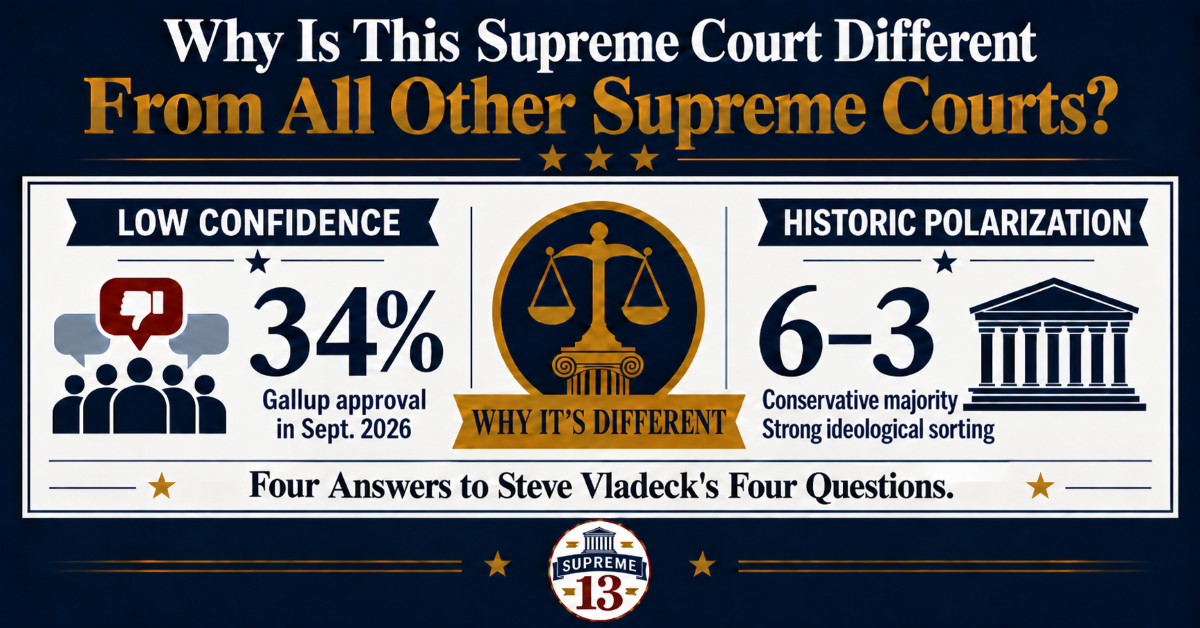
On October 15, 2026, Georgetown Law professor Steve Vladeck published an essay in which he expressed "grave concerns" about Supreme Court expansion and questioned why expansion should be prioritized over other reforms. He argued:
[Expansion] not only won’t do anything to solve the underlying problem (the Court’s complete lack of accountability), but it will almost certainly produce some (to my mind) deeply undesirable, if not disastrous, medium- and long-term effects along the way.
Steve Vladeck, One First, Bonus 257: Hard Questions About Court Expansion
He then challenged supporters of what he called an "expansion-or-bust" approach to do more than assert that adding four Democratic appointees to the Court in 2029 would be beneficial, and he posed four questions about the potential consequences of expansion.
Before addressing those questions, however, it is important to examine how the Supreme Court acquired its current 6–3 conservative majority and why proponents of expansion believe that changing its composition should take priority over other reforms.
How Did We Get Here?
As discussed previously, from 1970 through 2025, there was a significant disparity between the share of time Republicans held the presidency and their share of Supreme Court appointments. Republican presidents occupied the White House for 32 of those 56 years (57 percent) but appointed 14 of the 19 justices (74 percent) who joined the Court during that period. This disproportionate share of appointments has helped produce the current 6–3 conservative majority.
For a variety of reasons, the public standing of this 6–3 Court is historically weak. According to a recent Gallup poll, the Supreme Court began its 2026–2027 term with a near-record-low job approval rating of 34 percent among U.S. adults and just 12 percent among Democrats. Trust in the judicial branch also reached a historic low in Gallup's polling, with only 46 percent of adults and 23 percent of Democrats expressing a great deal or fair amount of trust.
Why is this Court so unpopular? Its unusually conservative composition and ideological polarization may be contributing factors. In a peer-reviewed study, political scientists Charles M. Cameron and Jonathan P. Kastellec examined how the Court's current 6–3 conservative majority emerged and how its ideological composition compares with that of earlier Courts. They concluded:
[T]he contemporary court is more conservative than at any time in the past 70 years, and probably longer. If the theories of the court underlying the measures have any merit, then one should expect this court strongly to favor conservative-identifying litigants over liberal-identifying ones and to produce many extremely conservative majority opinions—in other words, conservative law. The bloc measures suggest that labeling the contemporary court "a conservative Warren court" is somewhat inapt, because the landmark Warren court contained a group of moderates who somewhat restrained the liberal majority as it made law. No such bloc exists on the contemporary court.
Charles M. Cameron and Jonathan P. Kastellec, "The Supreme Court: How Did We Get Here? And What Comes Next?" The ANNALS of the American Academy of Political and Social Science (2024).
It is therefore unsurprising that in a September 2026 Marquette Law School Poll, 57 percent of U.S. adults believed Supreme Court justices' decisions were motivated mainly by politics rather than law. While the poll reflects public perceptions of the justices' motivations, the Court's conservative direction is evident in its decisions. As Justice Elena Kagan recently observed, "This court is deeply conservative and has accomplished and has put forward many things that have long formed part of the conservative legal agenda."[1]
The Court's historically low public confidence and unusual ideological polarization raise a question central to the debate over expansion:
What are the institutional consequences of maintaining the existing Court, and how should those consequences be weighed against the potential risks of expansion?
Why Court Expansion?
A central disagreement among advocates of Supreme Court reform is whether measures short of expansion can adequately address the Court's problems or whether expansion should take priority.
One approach, supported by some Republicans as well as Democrats, emphasizes term limits, stronger ethics rules, and greater transparency without expanding the Court. Fix the Court, for example, opposes expansion but advocates reforms intended to “make the federal courts, and primarily the U.S. Supreme Court, more open and more accountable to the American people.”[2]
Other advocates, including Take Back the Court, Demand Justice, and Supreme 13, support many of these same reforms but argue that they are insufficient to address the Court's current ideological composition. They view expansion as necessary to bring about a more immediate change in the Court's membership. They also question whether statutory reforms intended to increase the Court's accountability would survive constitutional review by the current justices.
Unlike high-court judges in most other countries,[3] U.S. Supreme Court justices have neither fixed terms nor a mandatory retirement age. Combined with strategic retirements and the unpredictable timing of vacancies, this arrangement can preserve a particular ideological majority for decades. For proponents seeking to change that majority sooner, expansion offers the most direct, constitutionally permissible means of doing so without waiting for vacancies.
With that background, the following sections address Professor Vladeck's four questions.
Question 1: How Do We Avoid a Race to the Bottom?
How do we avoid touching off a race to the bottom, where each time one party controls the House, Senate, and presidency, it expands the Court to ensure an ideologically and politically sympathetic majority?
At its core, this question concerns the risk that each party, upon gaining control of Congress and the presidency, would expand the Court to secure a favorable ideological majority. Such a cycle could damage judicial independence. But whether that possibility makes expansion worse than maintaining the status quo depends in part on whose interests are being considered.
For Republicans who favor the Court's current conservative direction, expansion would threaten a 6–3 majority that, with strategic retirements, could endure for decades. See Supreme Court Justices Shouldn’t Choose Their Successors. They therefore have a strong incentive to maintain the Court's existing composition.
For Democrats, expansion in 2029 could produce significant short-term benefits. If a Democratic president and Congress expanded the Court to 13 justices and the four new appointees produced a 7–6 progressive majority, Democrats could reasonably anticipate more favorable rulings. But having opened the door to expansion, they would also face the risk that a future Republican president and Congress might enlarge the Court again to reverse that majority. The direct answer to Professor Vladeck's first question is therefore that there is no way to guarantee that future Congresses would refrain from further expansion if they believed it served their political interests.
There are two important considerations in assessing that risk.
First, if Democrats expand the Court in 2029 and establish a progressive majority, its future composition could become an issue in every subsequent election. But why should that not be the case? The Court's composition already becomes an important political issue whenever a vacancy appears likely. Why should the electorate consider the future direction of the Court only when an appointment opportunity is anticipated, rather than more regularly through the election of presidents and members of Congress?
Second, Democrats have been more vocal than Republicans in advocating Supreme Court reform. If the roles were reversed, however, and Democrats enjoyed the prospect of decades with a 7–6 progressive majority, there is no guarantee that they would continue to support reforms that might jeopardize that advantage. Nevertheless, given the greater support for Supreme Court reform among Democrats under the current 6–3 conservative majority, proponents of reform may reasonably conclude that meaningful changes are more likely to be pursued by a Democratic president and Congress than by their Republican counterparts.
Faced with a progressive majority, Republicans would then have to decide how to respond. One possibility would be to seek control of Congress and the presidency and expand the Court again. Alternatively, recognizing the risk of an endless cycle of retaliation, they might be willing to negotiate with Democrats over a constitutional amendment establishing regularized Supreme Court appointments and limits on judicial tenure. If such an amendment were adopted, it could make it more difficult for either party to maintain an ideological majority for decades while giving the electorate a more predictable opportunity to influence the Court's future direction.
Would Republicans be willing to negotiate after losing their 6–3 conservative majority? Perhaps not, at least initially. But if Democrats made clear that expansion was intended to be accompanied by lasting reforms to the appointment process, negotiations might eventually become more attractive to both parties.
Professor Vladeck's question, however, goes beyond the consequences of expansion for Democrats and Republicans. He argues that departing from the longstanding norm of nine justices could damage the Supreme Court as an institution. Although he explores that concern further in his remaining questions, the history of changes to the Court's size, along with recent expansions of state supreme courts amid disputes over partisan motivations, provides important context.
As Professor Vladeck acknowledges, and as explained previously (see The Constitutionality of Expanding the Supreme Court), Congress has changed the size of the Supreme Court on several occasions. Those changes did not deprive the Court of its constitutional authority or its ability to issue binding decisions. More recently, Arizona and Georgia expanded their supreme courts in 2016, and Utah did so in 2026. Those courts also continued to exercise their judicial authority, despite those expansions having generated debate over judicial independence and partisan motivations. Indeed, the partisan inconsistency is striking, as documented by Eric Levitz in his 2020 article, Republicans Oppose Court Packing (Except When They Support It) (Intelligencer, October 14, 2020).
Of course, historical examples do not resolve Professor Vladeck's concern that breaking the longstanding nine-justice norm could encourage successive partisan expansions. There is no way to guarantee that future Congresses will not engage in an endless cycle of retaliation. But the risk of partisan retaliation is not the same as the certainty of partisan retaliation. The appropriate comparison is not expansion against a risk-free status quo, but expansion against the consequences of retaining the existing Court.
Question 2: Would Expansion Undermine Public Confidence?
If a race to the bottom is unavoidable, how do we avoid further (and potentially fatal) erosion of public confidence in the Court—which will quite transparently be little more than a lever of power for whichever party last had such a trifecta?
In this question, Professor Vladeck considers a scenario in which expansion by Democrats prompts successive retaliatory expansions by Republicans and Democrats. Under that scenario, he warns:
[W]e will have done permanent, irrevocable damage to the idea that the Supreme Court is doing anything other than partisan politics. To the contrary, it will be crystal clear to all involved that the Court reflects little more than the preferences of whichever party last controlled the House, Senate, and presidency at the same time.
First, Professor Vladeck's concern must be evaluated against the Court's existing public standing. As noted above, public confidence is already at a historic low, particularly among Democrats. If Democrats have an opportunity to expand the Court in 2029 but choose not to, strategic retirements and unpredictable vacancies could leave its conservative majority intact for decades. In that event, the dissatisfaction many Democrats already express toward the Court will likely deepen.
Second, concerns that expansion would make the Court appear more political must be considered in light of the existing appointment process. Supreme Court justices are nominated by presidents and confirmed by the Senate, with judicial and political philosophies playing a crucial role in their selection. Although justices have not always ruled as their appointing presidents might have preferred, modern nominees are carefully vetted, making it increasingly unlikely that their judicial philosophies will differ substantially from those of the presidents who nominate them. Nevertheless, once appointed, justices enjoy the independence afforded by Article III's guarantee of tenure during good behavior and are not obligated to rule as their appointing presidents would prefer.
Third, the Court's ideological composition is already influenced by electoral outcomes. If Democrats win control of the presidency and Congress in the 2028 elections, they could expand the Court in 2029 and appoint four new justices expected to have progressive judicial philosophies. Alternatively, if Democrats control the presidency and the Senate and a conservative justice leaves the Court, they could appoint a progressive successor. In either case, once a seat is available, the constitutional nomination and confirmation process is the same, and the new justices would be selected by elected officials whose decisions reflect, at least in part, their political and judicial preferences.
Professor Vladeck's ultimate concern here is that successive expansions could undermine the Court's credibility and its ability to “stand up to democratic majorities, tyrannical or otherwise.” He acknowledges that the current Court has failed to restrain the Trump administration in many instances, but his concern is that further expansion could undermine even that remaining ability to check executive power. Nevertheless, critics question whether the current Court has adequately restrained the administration, particularly in cases involving its assertions of executive power. They point, for example, to the Court's emergency-docket decisions, which, according to the Brennan Center's tracker through October 21, 2026, have favored the Trump administration substantially more frequently than opposed it. Indeed, the September 2026 Marquette Law School Poll found that 54 percent of U.S. adults believed the Court was going out of its way to avoid issuing a ruling President Trump might refuse to obey.
An analysis published October 19, 2026, by Adam Feldman on SCOTUSblog provides additional insight into the justices' treatment of executive-branch actions. Examining emergency applications under the Biden and Trump administrations, Feldman found that Justices Thomas, Alito, and Gorsuch supported executive-branch positions substantially more frequently under Trump's second administration than under Biden, while Justices Kagan, Sotomayor, and Jackson exhibited the reverse pattern. Chief Justice Roberts and Justice Kavanaugh, by comparison, were relatively consistent across administrations.
These differences do not establish the justices' motivations. As Feldman acknowledges, the administrations brought different kinds of cases involving different legal questions and procedural circumstances. Nevertheless, the findings raise questions about whether individual justices' approaches to executive authority depend in part on the administrations involved. And concerns about results-oriented judicial reasoning are not confined to progressives. Conservative commentators have also criticized Justice Samuel Alito for what they regard as results-oriented decision-making. See Ian Millhiser, The Surprising Conservative Backlash Against Justice Alito (Vox, October 20, 2026).
Ultimately, a lawfully expanded Supreme Court would possess the same constitutional authority as the existing Court. Its judgments would bind the parties, its precedential holdings would bind lower courts, and executive officials would remain obligated to comply with applicable judicial orders. A future president might refuse to comply with an expanded Court's decisions, but that possibility exists regardless of the Court's size. The harder question is whether expansion would make such defiance or an erosion of public confidence more likely. It might. But Congress has changed the Supreme Court's size before without depriving it of its constitutional authority or ability to issue binding decisions. Although those historical examples cannot establish how a future expansion would affect public confidence or compliance with judicial decisions, they provide reason to question whether the “disempowerment” Professor Vladeck fears would necessarily follow.
Question 3: What About Public Confidence in the Lower Federal Courts?
If eroding public confidence in the Court is a feature, and not a bug, how do we insulate against the same erosion of public confidence in lower federal courts?
In introducing his third question, Professor Vladeck raises concerns that expansion could damage the Court's "moral authority," particularly its ability to impose legal constraints on elected officials. But how should that authority be evaluated when Americans disagree so sharply about the Court's substantive decisions? For some, the Supreme Court asserted "moral authority" when it issued its decision in Roe v. Wade, interpreting the Constitution to recognize a constitutional right to obtain an abortion. For others, it asserted "moral authority" in Dobbs v. Jackson Women's Health Organization, when it reversed Roe. These opposing views illustrate how perceptions of the Court's moral authority can depend on whether one agrees with its substantive decisions. Although agreement with a particular ruling is not necessarily the same as confidence in the Court's institutional legitimacy, these differing perceptions complicate any assessment of the Court's “moral authority.”
The meaning of "public confidence" is similarly complicated. In Gallup's September 2026 survey, 79 percent of Republicans expressed a great deal or fair amount of trust in the judicial branch headed by the Supreme Court, compared with just 23 percent of Democrats. Thus, the overall figure of 46 percent conceals a profound partisan divide. Indeed, an expansion that diminishes confidence among Republicans might simultaneously increase confidence among Democrats. So, when Professor Vladeck warns that expansion could erode public confidence, an important question is whose confidence would be diminished, whose might be restored, and whether the resulting change would strengthen or weaken the Court's overall institutional legitimacy.
As for the lower courts, expanding the Supreme Court would not directly change the composition or responsibilities of the district and circuit courts. District judges would continue to resolve disputes and make factual findings, while circuit courts would continue to review their decisions. Both would remain bound by applicable Supreme Court precedent. For example, before Dobbs, lower federal courts were required to follow Roe and Casey. After Dobbs overruled those decisions, they were required to apply the new controlling precedent. That legal hierarchy would remain unchanged under an expanded Supreme Court.
Nevertheless, because these courts form part of the same federal judicial system, concerns about the Supreme Court's independence could affect public confidence in the lower courts as well. But Professor Vladeck himself has argued that the existing Supreme Court is already undermining the authority of the lower federal courts. In a July 2026 essay introducing his forthcoming Harvard Law Review Foreword, he wrote:
Through an accelerating series of emergency-docket interventions—and through its merits rulings, its rhetoric, and its silences—the Court has stayed, narrowed, or vacated district court orders, often without full briefing, argument, or reasoned explanation, while treating trial judges’ considered factfinding and legal conclusions as provisional placeholders to be revisited at the justices’ discretion. Using seven sets of cases from the past eighteen months, I show that the Court has done significant damage to the formal, practical, and moral authority of federal district courts to hold the federal government to account—all while arrogating much of that same authority to itself, with respect to factfinding, law-finding, the timing and scope of appellate review, and the balancing of the equities.
Steve Vladeck, One First, Bonus 238: The Court Against the Courts
Although expansion could create additional risks, how should those risks be weighed against the damage Professor Vladeck himself attributes to the status quo? If Congress concludes that the existing Court has undermined the lower federal courts, expansion would provide an opportunity for senators to question four additional nominees about their views on the authority of those courts. An expanded Court might subsequently take a different approach to its relationship with the lower federal judiciary. That outcome cannot be guaranteed, but the existing Court's treatment of lower courts should also be considered when evaluating the risks of expansion.
Protecting public confidence in the lower federal courts requires more than preserving the current composition of the Supreme Court. It also requires respect for the independence and responsibilities of district and circuit judges, including compliance with their judicial orders. Those protections are important regardless of whether Congress expands the Supreme Court. Expansion might create additional risks to public confidence, but preserving the existing Court does not eliminate the threats to lower-court authority that Professor Vladeck himself has identified.
Question 4: Why Is Expansion Preferable to Alternative Reforms?
What is the case for why expansion is a better way to achieve the desired reforms than alternatives that would (or, at least, should) avoid many of these forward-looking concerns?
Here, Professor Vladeck poses the following further challenge:
[G]iven the wide range of other reform ideas that are already in the water, it sure seems like the burden ought to be on expansion's proponents to explain why these other reforms would be inadequate to whatever the actual goal is.
In an April 15, 2024, piece, Professor Vladeck described three broad categories of Court reform. The first consists of "composition-changing reforms," such as Court expansion. For advocates seeking an immediate change to this Court's composition in response to its conservative rulings, including many of the organizations listed on the Supreme 13 website, expansion offers a direct means of changing the Court's membership without waiting for vacancies. Professor Vladeck, though, noted that he is "wary" of such reforms, and his recent four questions demonstrate his continuing concern about Court expansion. So what, then, of the other two categories?
The second category consists of "power-limiting reforms," including statutes that could limit the Supreme Court's ability to hear certain cases. But as to these reforms, Professor Vladeck acknowledges that measures sweeping enough to produce immediate changes may encounter greater constitutional uncertainty, while constitutionally safer measures may produce more limited results.
That leaves his third category, "accountability-enhancing reforms," upon which Professor Vladeck has placed the greatest emphasis. These "other reform ideas" include (1) expanding the Court’s mandatory docket; (2) an Article III Inspector General; (3) codification of existing standards for emergency relief; (4) more public congressional oversight of the Court (including of its budget); and (5) more congressional engagement in the Court’s day-to-day work.
But the actions of the current Court since April 2024 raise questions about whether these reforms would be sufficient to address its existing problems, particularly when congressional leaders are unwilling to exercise meaningful oversight. As Professor Vladeck acknowledges, accountability-enhancing reforms would have limited immediate impact and would not directly prevent the existing majority from deciding cases as it chooses. Although he argues that greater congressional engagement could influence the Court's behavior over time, such reforms would leave the Court's ideological composition unchanged, and any effect on its constitutional rulings would be indirect and uncertain.
Professor Vladeck also points to the Supreme Court's response to President Franklin Roosevelt's proposed expansion in 1937, arguing that congressional pressure can influence the Court without requiring additional justices. But the extent to which Roosevelt's proposed expansion, rather than other developments, caused the Court to change direction remains disputed.[4] More importantly, the historical example does not establish that reforms short of expansion would produce a comparable response from the current Court. Nor is it clear that the threat of expansion would exert meaningful pressure if those making the threat were unwilling to follow through.
Professor Vladeck also discussed term limits as a longer-term reform that could eventually change the Court's composition, but there are serious constitutional risks of attempting to impose them by statute. See Supreme Court Term Limits Cannot Substitute for Court Expansion. Indeed, as Professor Vladeck noted in 2023, during a discussion of proposed congressional ethics requirements for the Supreme Court, Justice Samuel Alito asserted that "No provision in the Constitution gives [Congress] the authority to regulate the Supreme Court—period." Although Professor Vladeck strongly disputed that assertion, Alito's statement illustrates a practical concern: the constitutionality of congressional reforms intended to constrain the Court could ultimately be decided by the very justices those reforms seek to regulate. If a majority adopted Alito's position, some statutory reforms might be invalidated before they could have any meaningful effect.
Professor Vladeck has also suggested that resistance to modest accountability reforms could itself build support for stronger measures. But that possibility provides no guarantee that the initial reforms would survive judicial review or produce meaningful changes to the Court's conduct. Proponents of those reforms should therefore explain how they would address the possibility that the Court itself might invalidate them.
As reflected in public-opinion polling, until fairly recently, a majority of Americans expressed trust in the judicial branch headed by the Supreme Court, despite many of the same institutional accountability arrangements that exist today. That history raises questions about whether the Court's lack of accountability, standing alone, explains its declining public confidence. Greater transparency and congressional oversight might improve institutional practices, but they would not directly change the Court's ideological composition or the constitutional decisions that have contributed to public dissatisfaction. Such reforms might also do little to restore confidence among Americans whose dissatisfaction stems primarily from the Court's substantive decisions.
Finally, by focusing on the potential damage to the Court's credibility from expansion, Professor Vladeck gives insufficient consideration to the possibility that expansion could also restore confidence among Americans who have lost faith in the existing Court. What if the Court's present composition and decisions, rather than its accountability arrangements alone, are important contributors to its declining public standing? Accountability reforms may be worthwhile, but proponents of those reforms must also explain whether they can adequately address the consequences of maintaining the current Court's ideological majority.
Is It True That Calls for Expansion Have Been Substantially Undertheorized?
A final note about Professor Vladeck's column.
In his essay, Professor Vladeck argues that calls for Supreme Court expansion have "thus far been substantially undertheorized." His criticism is directed particularly at proponents who prioritize adding four justices in 2029 without, in his view, adequately addressing the potential consequences for judicial independence, public confidence, the lower federal courts, and future partisan retaliation. Those concerns deserve serious consideration. But they have also been the subject of substantial scholarly and institutional analysis.
For example, the Final Report of the Presidential Commission on the Supreme Court of the United States (2021) examined the arguments for and against expansion, including the potential consequences for judicial independence, legitimacy, and future partisan retaliation. Similarly, the Harvard Law Review article Confusion and Clarity in the Case for Supreme Court Reform (2024) examined competing theories of Court reform, including the risks of politicizing changes to its composition.
One of the main features of the Supreme 13 website is its growing collection of scholarship and research (26 entries), news articles (39 entries), opinion pieces (74 entries), and interviews (24 entries) concerning Supreme Court expansion. These 163 entries (as of October 21, 2026) provide readers with access to a substantial body of research, reporting, and commentary addressing the arguments for and against expansion.
Professor Vladeck may find the arguments for expansion presented in these works unpersuasive, but that is not the same as demonstrating that the case for Supreme Court expansion has been substantially undertheorized. The risks he identifies have been examined extensively. The real disagreement is over how those risks should be weighed against the consequences of preserving the existing Court.
Supreme Court Expansion Remains the Best Option to Effect Needed Change
For many supporters of expansion, the concern is not simply that the current Court is conservative, but that it may subject a future Democratic administration to greater scrutiny than it has applied to the second Trump administration. Professor Vladeck himself has criticized what he regards as inconsistent treatment of politically charged disputes, including redistricting cases in Alabama, Louisiana, and New York. See 226. Two More Data Points for the Inconsistent Court.
Professor Vladeck has also observed that, on the current Court, "the ideological orientation of the justices maps perfectly onto the party of the president who appointed them." See also Nathan Newman, We’ve Never Had a Partisan Court Before. That’s the Case for Packing It (Left Future, June 18, 2026). That alignment does not establish that individual justices decide cases for partisan reasons. But it helps explain why advocates who believe the Court's current membership is itself a problem are unwilling to rely exclusively on reforms that leave its composition unchanged. For those advocates, expanding the Supreme Court to 13 justices is not a substitute for other reforms. It is an essential part of them.
Comments
Join the conversation on Bluesky
Where 6 of 9 & 100's more like them are neither "Imminently Qualified or Independent" (Federalist 79p1) & are, all "Religious Tested" in violation of our Const ART VI & many were seated by 14A violations who Obstructed Congress to create 100's of Judicial Br vacancies You have suffered a coup