
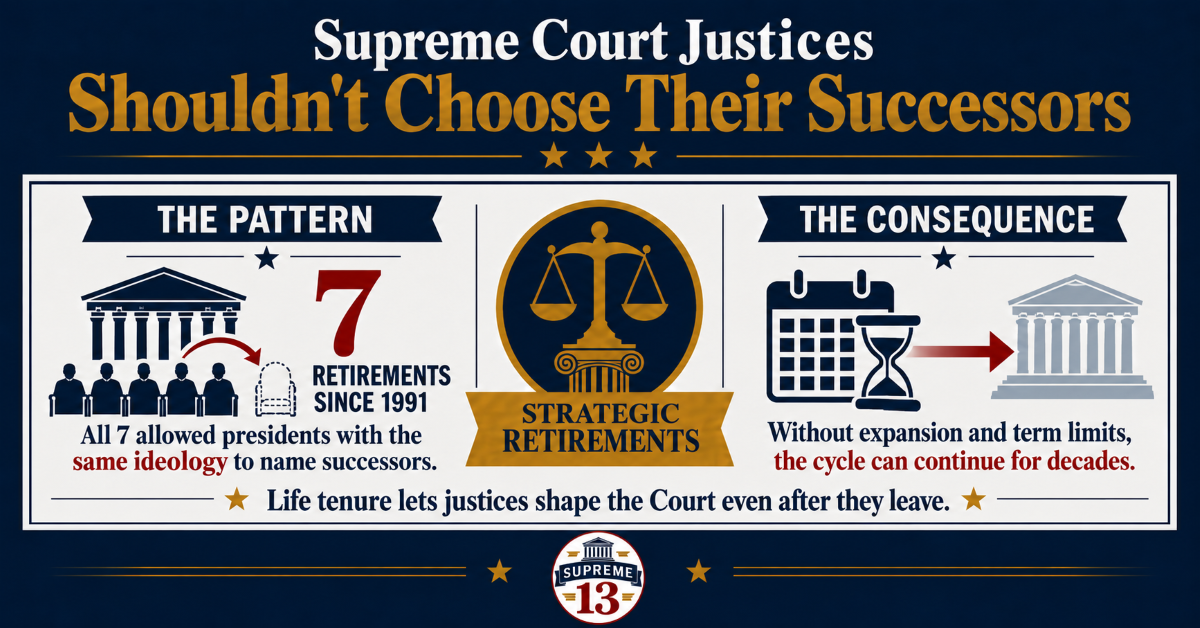
On June 27, 1991, Justice Thurgood Marshall, who had been appointed by Democratic President Lyndon B. Johnson, announced that he would retire effective October 1 of that year. In his place, Republican President George H.W. Bush nominated Clarence Thomas, who will complete 35 years of service on October 23, 2026.
Had Marshall remained on the Court until his death, the vacancy would have arisen on January 24, 1993—just four days after Bill Clinton became president.
As Stephen Spaulding of the Brennan Center for Justice has observed, the Marshall-to-Thomas transition marked the last time a Supreme Court justice retired when the resulting vacancy was likely to produce a justice with an opposing ideology.
Strategic Retirements at the Supreme Court
Strategic retirements allow judges to effectively choose their successors, or at least their successors’ judicial philosophies, thereby extending their influence on the Supreme Court. This in turn reinforces a belief that the Court is a political body where justices do the bidding of the politicians and interests that supported their appointment — or forward their own personal political agenda. It undermines the principle that the rule of law controls the future of American jurisprudence.
Strategic Retirements Hurt the Supreme Court. Term Limits Would End Them, Stephen Spaulding, Brennan Center for Justice (June 24, 2025)
Writing later that year at SCOTUSblog, Adam Feldman described an even more personalized form of judicial succession:
The judges themselves have developed their own succession strategies. In recent years, a striking pattern has emerged: Supreme Court justices now appear ready to retire only with tacit – or perhaps explicit – assurances that they will be replaced by someone they helped shape, typically a former clerk.
A Justice's Most Lasting Legacy, Adam Feldman, SCOTUSblog (November 14, 2025)
Strategic retirements can damage both the Court as an institution and public confidence in the judiciary. As Spaulding notes, "the Court's legitimacy depends in part on public confidence that it is deciding cases based on the law and constitutional values, not on its members’ political preferences." When Supreme Court justices can time their retirements to increase the likelihood of a like-minded successor, changes in control of the presidency and Senate do not necessarily translate into corresponding changes in the Court. And that dynamic has helped Republican-appointed justices maintain a majority on the Court continuously since 1970.
Supreme Court Retirements and Succession Since 1991
Since Marshall's departure in 1991, the following seven justices have retired, with none doing so when a vacancy was likely to produce a successor of the opposing ideology:
- Byron White (John F. Kennedy - D) → Ruth Bader Ginsburg (Bill Clinton - D)
- Harry Blackmun (Richard Nixon - R) → Stephen Breyer (Bill Clinton - D)
- Sandra Day O'Connor (Ronald Reagan - R) → Samuel Alito (George W. Bush - R)
- David Souter (George H.W. Bush - R) → Sonia Sotomayor (Barack Obama - D)
- John Paul Stevens (Gerald Ford - R) → Elena Kagan (Barack Obama - D)
- Anthony Kennedy (Ronald Reagan - R) → Brett Kavanaugh (Donald Trump - R)
- Stephen Breyer (Bill Clinton - D) → Ketanji Brown Jackson (Joe Biden - D)
Blackmun, Stevens, and Souter were identified with the Court's liberal wing by the ends of their tenures, so it is unsurprising that each retired during a Democratic presidency, allowing Democratic presidents to nominate their successors.
When Supreme Court Vacancies Come Through Death
As David Daley writes in The Nation, "Supreme Court retirements have become a morbid blend of constitutional hardball and actuarial risk management."
Since Marshall's retirement, three justices have died in office. Rehnquist and Ginsburg died while Republican presidents were in office and were succeeded by nominees of those presidents. Scalia, by contrast, died during Barack Obama's presidency, but the Republican-controlled Senate declined to act on Obama's nomination of Merrick Garland, leaving the vacancy for Donald Trump to fill after taking office.
- William Rehnquist (Richard Nixon - R) → John Roberts (George W. Bush - R)
- Antonin Scalia (Ronald Reagan - R) → Neil Gorsuch (Donald Trump - R)
- Ruth Bader Ginsburg (Bill Clinton - D) → Amy Coney Barrett (Donald Trump - R)
The Succession Calculus for Thomas and Alito
Against that background, consider the ages of the Court's current members as of September 16, 2026:
- Clarence Thomas, age 78 (George H.W. Bush - R)
- Samuel Alito, age 76 (George W. Bush - R)
- Sonia Sotomayor, age 72 (Barack Obama - D)
- John Roberts, age 71 (George W. Bush - R)
- Elena Kagan, age 66 (Barack Obama - D)
- Brett Kavanaugh, age 61 (Donald Trump - R)
- Neil Gorsuch, age 59 (Donald Trump - R)
- Ketanji Brown Jackson, age 56 (Joe Biden - D)
- Amy Coney Barrett, age 54 (Donald Trump - R)
Alito has said that he intends to remain on the Court through at least the coming Term, while sources close to Thomas have reported that he does not plan to step down this year. But if Democrats take control of the Senate in November and Thomas and Alito remain on the Court when the new Senate takes office in January, the political circumstances surrounding any subsequent vacancy would change. At that point, Thomas and Alito would have to be prepared to serve until ages 80 and 78, respectively, if they don't wish to give Democrats the chance to repeat the Garland blockade. And if 2028 brings a Democratic presidency, they would need to be willing to serve until ages 84 and 82, respectively, to avoid possibly turning their seats over to a justice of an opposing ideology.
Life Tenure, Term Limits, and Supreme Court Expansion
The ability of Supreme Court justices to serve for decades and then influence the ideological direction of their succession stands in sharp contrast to the regular electoral accountability of the elected branches.
Every two years, voters elect the entire House and roughly one-third of the Senate seats. Every four years, voters elect a president.
But the justices of the Supreme Court? They never stand for election. Removal requires impeachment by the House and conviction by the Senate, and no justice has ever been removed through that process. Samuel Chase, the only justice ever impeached, was acquitted by the Senate in 1805.
Of course, it is generally acknowledged that judges should be at least somewhat insulated from political pressures. But the United States is an outlier in granting the justices of its highest court life tenure. Even worse, as Daley notes, this system can allow "Supreme Court seats to be passed from one generation of a political movement to the next."
Term limits paired with regularized appointments would directly address the strategic-retirement problem by making appointments more predictable and less dependent on individual justices' retirement decisions. Some scholars and reform organizations, including the Brennan Center, contend that such a system can be enacted constitutionally by statute. But as discussed on this blog, there is a risk in relying on this Court to uphold the constitutionality of term limits. That constitutional uncertainty is one reason Supreme 13 argues that expansion should precede term limits, so that if a subsequent challenge reached the Supreme Court, it would be considered by an expanded Court.
The problem is larger than Thomas, Alito, or any particular justice. So long as Supreme Court seats are held for life and justices may choose when to retire, every justice has an opportunity to influence not only the law during his or her tenure, but the ideological character of the Court after that tenure ends. No justice—conservative or liberal—should possess that kind of power over the succession to a public office.