
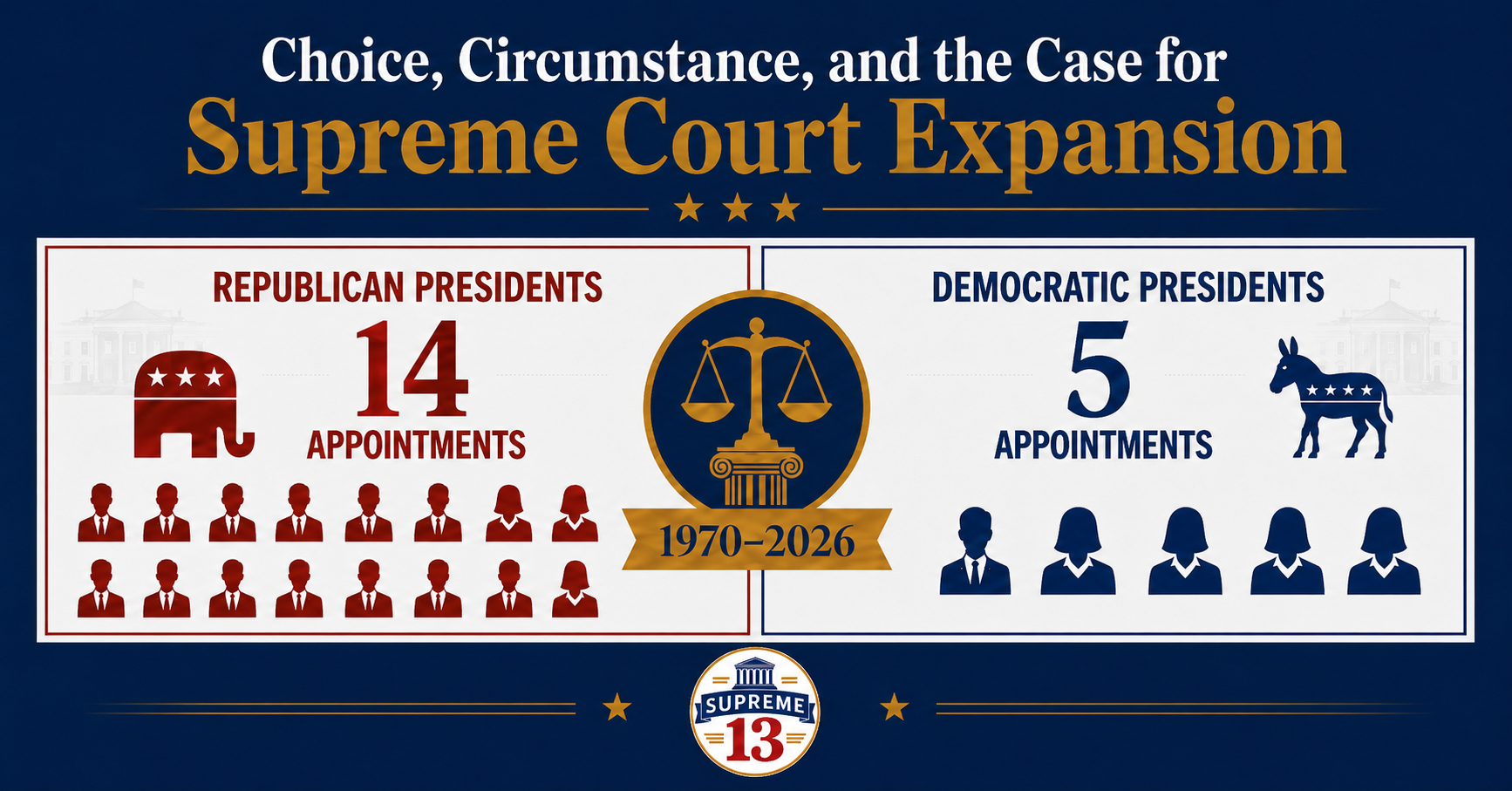
Since Justice Harry Blackmun joined the Supreme Court in 1970, no fully staffed Court has had a majority of justices appointed by Democratic presidents. That enduring imbalance reflects both chance and political choice.
Consider the disparity since 1970:
- The Presidency: As of July 2026, Republican presidents have occupied the White House for approximately 32 years, or 57% of the period, compared with approximately 24 years, or 43%, for Democratic presidents.
- The Supreme Court: During that period, Republican presidents appointed 14 new justices to the Court. Democratic presidents appointed only 5.
In other words, Republican presidents made approximately 74% of the appointments despite holding the presidency for about 57% of the period. Democratic presidents made only 26% of the appointments despite holding the presidency for roughly 43% of the time.
The Opportunity Cost of Restraint
Democrats held unified control of the presidency and both chambers of Congress during four periods totaling approximately 10 years: 1977–1980, 1993–1994, 2009–2010, and 2021–2022. During none of those periods did Democratic leaders make Supreme Court expansion a governing priority or enact legislation increasing the Court’s size.
There may once have been defensible institutional reasons for that restraint. But after the events surrounding the 2016 and 2020 vacancies—and the decisions subsequently issued by the resulting 6–3 majority—unilateral restraint is no longer a sustainable strategy.
If Democrats win the presidency and both chambers of Congress in 2028, structural reform should be treated not as an afterthought but as an essential part of protecting any legislative agenda enacted in 2029.
Following the State-Level Playbook
Changing the size of a high court is not an unprecedented departure from American practice. Republican-led governments enacted expansions of the Arizona and Georgia high courts in 2016 and expanded the Utah Supreme Court in 2026, creating new seats that Republican governors were able to fill. Arizona increased its court from five to seven justices, Georgia from seven to nine, and Utah from five to seven.
Supporters of those changes offered administrative and institutional justifications; critics described them as partisan court packing. Whatever label one applies, those precedents make it difficult to argue that changing a court’s size is inherently illegitimate when Democrats consider it at the federal level.
The lesson is not that political escalation is desirable. It is that one party cannot preserve institutional norms through unilateral restraint while the other party changes those norms whenever it has the power to do so. Supporters of reform should begin building public and political support now for expanding the Supreme Court to 13 justices so that, if voters provide the necessary mandate in 2028, Congress is prepared to act in 2029.
See the growing list of elected officials, state Democratic parties, and organizations that have endorsed Supreme Court expansion and help build the coalition needed to act in 2029.
Comments
Join the conversation on Bluesky