
Senator Sheldon Whitehouse (D-RI) recently reintroduced the Supreme Court Biennial Appointments and Term Limits Act of 2026. The bill would allow only the nine most recently appointed justices to hear cases arising under the Supreme Court’s appellate jurisdiction, which accounts for nearly all of the Court’s caseload.
Under the proposal:
- The president would appoint a new justice within the first 120 days of the first and third years of each presidential term, with the justice’s service beginning on July 1.
- As new justices joined the Court every two years, its longest-serving members would rotate off the nine-member panel that hears appellate cases.
- Each newly appointed justice would ordinarily serve 18 years on the active appellate panel.
- Senior justices would remain members of the Supreme Court, continue hearing the limited number of cases arising under its original jurisdiction, and retain other powers of their office.
Setting aside questions about how the statute would operate and legislative hurdles—including the likelihood of a Republican filibuster under current Senate rules—there are two fundamental reasons term limits cannot substitute for immediate expansion:
1. It Doesn’t Fix the Conservative Majority in the Short Term
The Supreme Court currently has a 6–3 conservative majority. Its five longest-serving members are Clarence Thomas, who joined the Court in 1991; Chief Justice John Roberts, who joined in 2005; Samuel Alito, who joined in 2006; Sonia Sotomayor, who joined in 2009; and Elena Kagan, who joined in 2010.
The legislation’s effective date creates an even greater delay than its biennial appointment schedule suggests. The bill would not begin operating immediately upon enactment. Instead, it would take effect at the beginning of the first full presidential term commencing after the bill became law.
That distinction is critical.
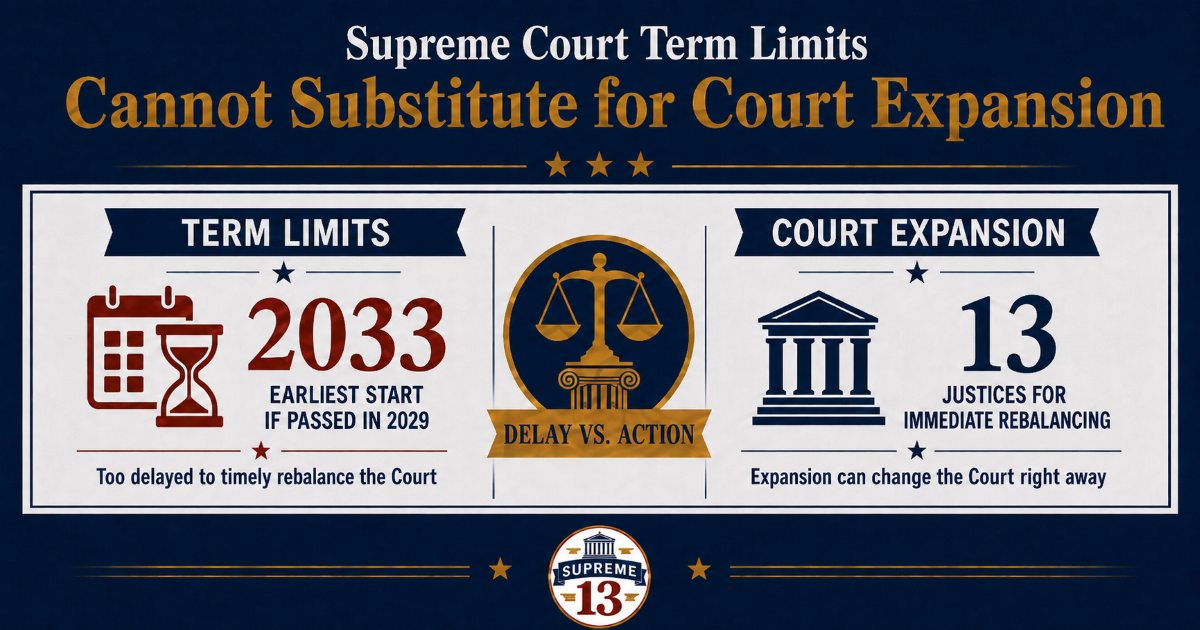
Suppose Democrats win the presidency and both houses of Congress in 2028 and enact the bill after a Democratic president takes office on January 20, 2029. Because that presidential term would already have begun, the law would not take effect until January 20, 2033, when the next presidential term would begin.
Assuming the Court’s current ideological balance remained in place, the new administration would therefore remain subject throughout its first term to a conservative-dominated Supreme Court with ample power to block progressive priorities—from invalidating agency regulations to striking down federal statutes as unconstitutional.
Term limits could gradually change the Court. They would not protect a new Democratic administration during the period when its major legislative and regulatory initiatives were most vulnerable.
2. A Conservative-Majority Court Could Decide Whether It Is Constitutional
The proposal also depends on a disputed constitutional theory surviving judicial review.
A recent Brennan Center for Justice memorandum argues that Congress can establish this system by statute without amending the Constitution. Under that analysis, the legislation would not remove justices from office or terminate their life tenure. It would instead alter their duties after 18 years of active service while allowing them to remain Supreme Court justices with senior responsibilities.
That is a substantial legal argument, supported by dozens of constitutional scholars and retired judges. But conservative and libertarian legal scholars have articulated opposing arguments that Congress cannot constitutionally impose this arrangement through ordinary legislation.
Examples include:
- Ilya Somin (Reason): Pitfalls of Statutory Term Limits for Supreme Court Justices, which argues that Congress cannot redefine the constitutionally protected office of a Supreme Court justice through ordinary legislation.
- Steven G. Calabresi & James Lindgren (Harvard Journal of Law & Public Policy): Term Limits for the Supreme Court: Life Tenure Reconsidered, which supports 18-year terms but proposes accomplishing them through a constitutional amendment.
- Michael Ramsey (The Originalism Blog): Are Limited Terms for Supreme Court Justices Constitutional?, which questions whether transferring justices away from the Court’s regular caseload is consistent with Article III of the Constitution.
Those objections may ultimately be wrong, but reformers cannot ignore the practical risk they create.
Term-limit supporters could therefore find themselves relying on a conservative-majority Court to uphold legislation designed to diminish that majority’s power.
That is an extraordinarily precarious foundation for reform.
The Bottom Line
Term limits and Supreme Court expansion should not be treated as competing ideas. Term limits are a worthy long-term reform that could regularize appointments, discourage strategically timed retirements, and prevent future justices from exercising power for several decades.
But the order of these reforms matters.
Expanding the Supreme Court from 9 to 13 justices would address the immediate crisis. Assuming four appointments aligned with a future Democratic administration, expansion would change the Court from a 6–3 conservative majority to a likely 7–6 progressive majority.
That would accomplish two essential goals:
- It would immediately rebalance the Court rather than requiring a future administration to wait years for biennial appointments to change its composition.
- It would reduce the risk that a conservative majority would invalidate subsequent term-limit legislation before the new system could take hold.
Neither reform can guarantee particular decisions, and no justice is an automatic vote. But unlike statutory term limits, court expansion rests on a clearer constitutional and historical foundation. The Constitution does not establish a fixed number of Supreme Court justices, and Congress has changed the Court’s size multiple times throughout American history.
Term limits may help build a healthier Supreme Court for future generations. They cannot, by themselves, protect a new administration from the existing conservative majority or ensure that statutory term limits survive constitutional review.
To give term limits the best chance of surviving constitutional review—and to achieve meaningful reform before another generation has passed—Supreme Court expansion must come first.
Comments
Join the conversation on Bluesky